







.svg)

.svg)
.svg)


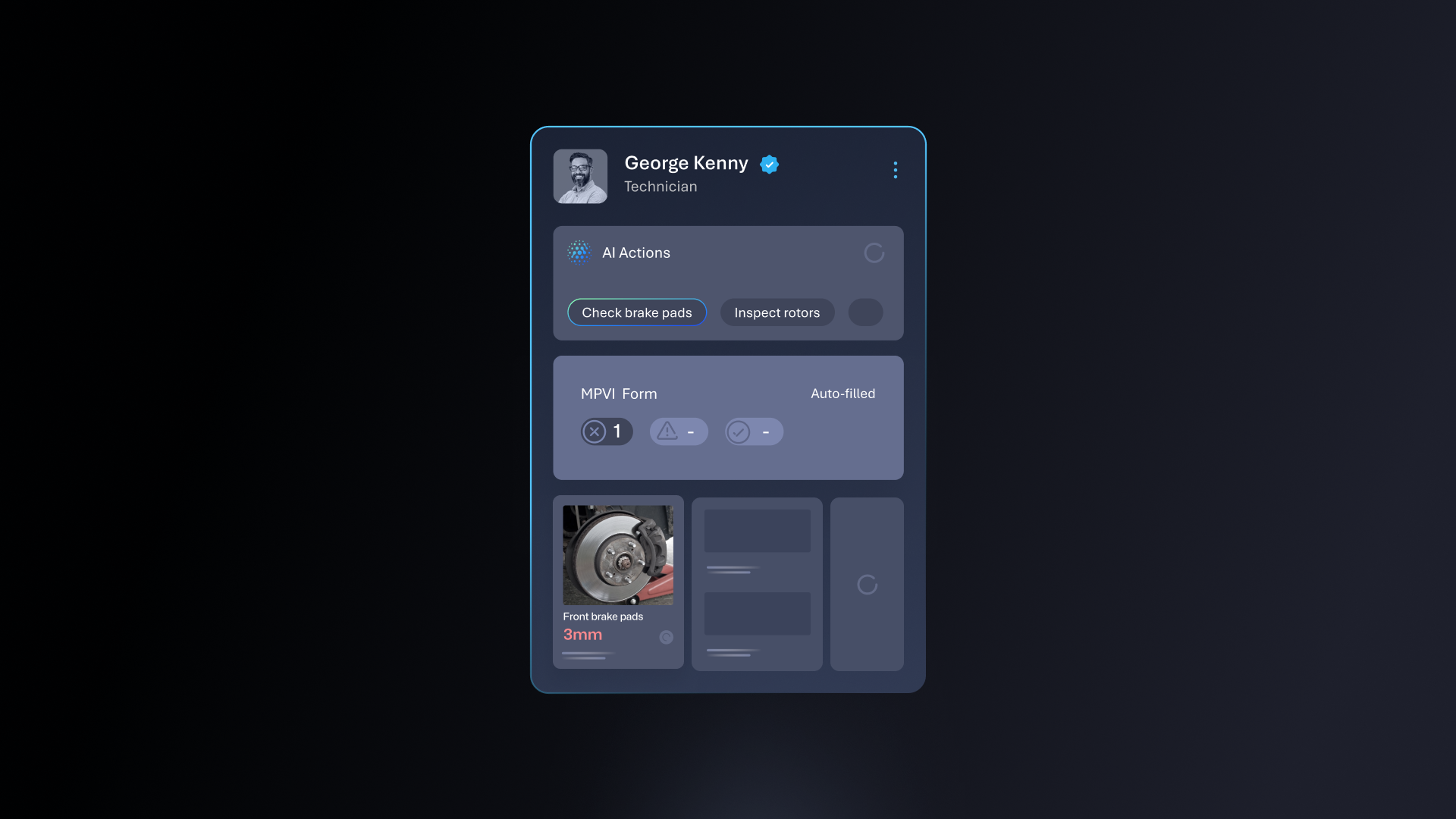

Over the past decade, cloud-native platforms, mobile-first workflows, and real-time data have transformed dealership operations. Yet vehicle inspections—one of the most critical revenue drivers in fixed operations—have remained fundamentally unchanged. Technicians still walk around vehicles, then return to terminals to manually fill out MPI forms, measure damage, assign severity flags, and attach clips.
Now that’s changing.
AI-powered vehicle inspection software reshaped how dealerships document conditions, approve repairs, and accelerate throughput. In this guide, we’ll break down what to look for in a modern inspection solution, how it delivers measurable ROI, and why the technology matters for your service department’s future.
What Is AI-Powered Vehicle Inspection Software?
AI-powered vehicle inspection software is a digital tool that automates the inspection workflow—from documentation to evidence delivery—using artificial intelligence to process video, audio, and vehicle data in real time.
Unlike traditional digital MPI tools (which replace a paper form with a digital one), true AI inspection software:
- Automatically populates inspection forms from technician video and voice narration, eliminating manual data entry
- Extracts evidence clips per concern—one video per finding—without manual trimming or editing
- Surfaces vehicle-specific inspection suggestions based on repair patterns across the Tekion Service Network
- Translates findings into clear recommendations with customer-ready language
- Reorders recommendations intelligently by likelihood of approval and safety criticality
- Delivers customer-facing evidence through consumer portals
- Integrates with the DMS so everything lives in one system—no middleware, no separate vendor portal
Modern inspection software reclaims those hours, compresses the entire workflow to minutes, and produces consistent, audit-ready records that hold up under scrutiny. More importantly, it moves customers from skepticism to approval faster because they see evidence.
The result is a workflow that’s faster, more consistent, and more persuasive to customers.
What to Look for in AI Vehicle Inspection Software
Not all inspection tools are created equal. When evaluating solutions, dealerships should assess six critical dimensions:
1. Hands-Free Workflow (Voice-to-Form)
Look for software that captures technician voice narration during the walk and auto-fills the inspection form.
2. Native DMS Integration (No Middleware)
The best tools run inside your existing DMS and read your actual live MPI form—every field, threshold, and configuration—not a generic external template.
3. Automatic Video Clipping & Evidence Delivery
The software should automatically identify and extract the moment of each concern from the recorded video, create a short clip, and queue it for customer delivery—all without technician or advisor intervention.
4. Data-Driven Inspection Guidance
Look for solutions that surface vehicle-specific inspection suggestions based on repair patterns observed across your network—by make, model, year, and mileage band.
5. Device Agnostic & Hardware-Light
The solution should work on any device a technician can log into your DMS—phone or tablet —with no new hardware investment, special cameras, or middleware.
6. Complete AI-Powered Workflow: Inspection to Advisor to Customer
Look for tools that automatically feed inspection findings through the entire service cycle: technician findings are captured once, converted into clear customer-ready recommendations, intelligently prioritized by approval likelihood, and presented by advisors without extra work or translation.
The Future of AI-Powered Vehicle Inspections: Technician & Advisor Agentic Workflows
Tekion’s technician and advisor agentic workflows—built natively into Automotive Retail Cloud (ARC) as part of Service AI—work together to move inspections from the bay to customer approval seamlessly. Together, they eliminate the friction points that slow inspections down and deliver measurable ROI across the entire recommendation cycle.
How the Technician Agentic Workflow Works
AI Inspection Suggestions:
Before the technician even walks the vehicle, the system surfaces data-driven inspection suggestions based on repair patterns observed across the dealer network for the make, model, year, and mileage. Each suggestion includes a recommended labor code and can be added with a single click.
The Walkaround:
A technician carries their device and records a single walkaround video while narrating findings—measurements, condition notes, and severity observations.
Form Population:
AI transcribes the narration, auto-populates MPI fields (including measurements and severity flags), and generates an inspection form. The technician reviews, confirms, and submits when ready.
Automatic Concern Clips:
For every warning or critical finding, AI automatically identifies the exact moment in the video and extracts a short clip to share with the customer.
How the Advisor Agentic Workflow Works
Marketable Recommendations:
When inspection findings arrive, the advisor workflow automatically generates clear, customer-ready recommendations combining condition (what’s wrong), risk (what happens if ignored), and benefit (why act now). Every recommendation is evidence-based, professional, and consistent—no advisor rewriting, no technical jargon.
Vehicle Health Summary:
The system generates a personalized, plain-language condition overview that appears in the customer portal. It adapts its tone to the actual condition mix—reassuring when all-green, attention-focused when critical items exist.
Smart Recommendation Ordering:
The advisor workflow automatically reorders recommendations by likelihood of approval and safety criticality, so the most compelling items surface first on the customer portal. Advisors can manually override at any time, and the system audit-logs all changes.
Consumer Portal Delivery:
Each clip is automatically branded with the dealer’s logo, contact info, and watermark, then delivered through the Consumer Portal alongside prioritized recommendations and the Vehicle Health Summary. Customers see evidence of every concern on their own vehicle, read a clear explanation, and review recommendations in priority order.
How They Work Together
The technician workflow captures findings. The advisor workflow translates them into clear, prioritized recommendations backed by video evidence. Together, they form a complete end-to-end system that moves from inspection to customer approval in minutes—not hours.
The workflow:
- Technician captures inspection: Video narration → auto-populated MPI → evidence clips queued
- Advisor workflow translates findings: Technician notes → customer-ready language + prioritized ordering
- Customer sees evidence + explanation: Vehicle Health Summary + prioritized recommendations + exact video per concern
- Result: Faster approvals, higher attachment rates, zero re-entry, one platform end-to-end
Ready to Transform Your Service Lane?
The inspection workflow doesn’t end when the technician walks away from the vehicle. It ends when the customer approves—and that’s where the technician and advisor agentic workflows work together.
The technician workflow captures findings. The advisor workflow transforms those findings into clear, prioritized, customer-facing recommendations backed by video evidence. Together, they move from inspection to customer approval faster—with better documentation, higher approval rates, and measurable ROI.
Request a demo to see how the technician and advisor agentic workflows work together inside your dealership—and how they transform your entire service lane from inspection to revenue capture.
.png)
.png)
.png)





.svg)