







.svg)

.svg)
.svg)


.png)

Today, most dealership AI is a feature bolted onto legacy software—forcing your team to pull data from multiple places before an AI agent can actually help. An AI-native dealer management system (DMS) is different: AI is built into the core architecture, running on unified data so agents can act immediately across sales, service, parts, and accounting without friction.
In automotive retail, "DMS" means dealer management system, the software that runs a dealership’s operations.
Modern Cloud DMS, AI-Powered DMS, AI-Native DMS: The Distinctions
What an AI-Native DMS Does in a Dealership
The practical test is whether the AI acts inside the workflow or sits beside it—whether it takes action or just shares suggestions. In Tekion's AI-native Automotive Retail Cloud (ARC), agents can completely automate dealer workflows because they are built into a unified platform with full dealership context.
- Service Scheduler AI: handles appointment scheduling and reminders
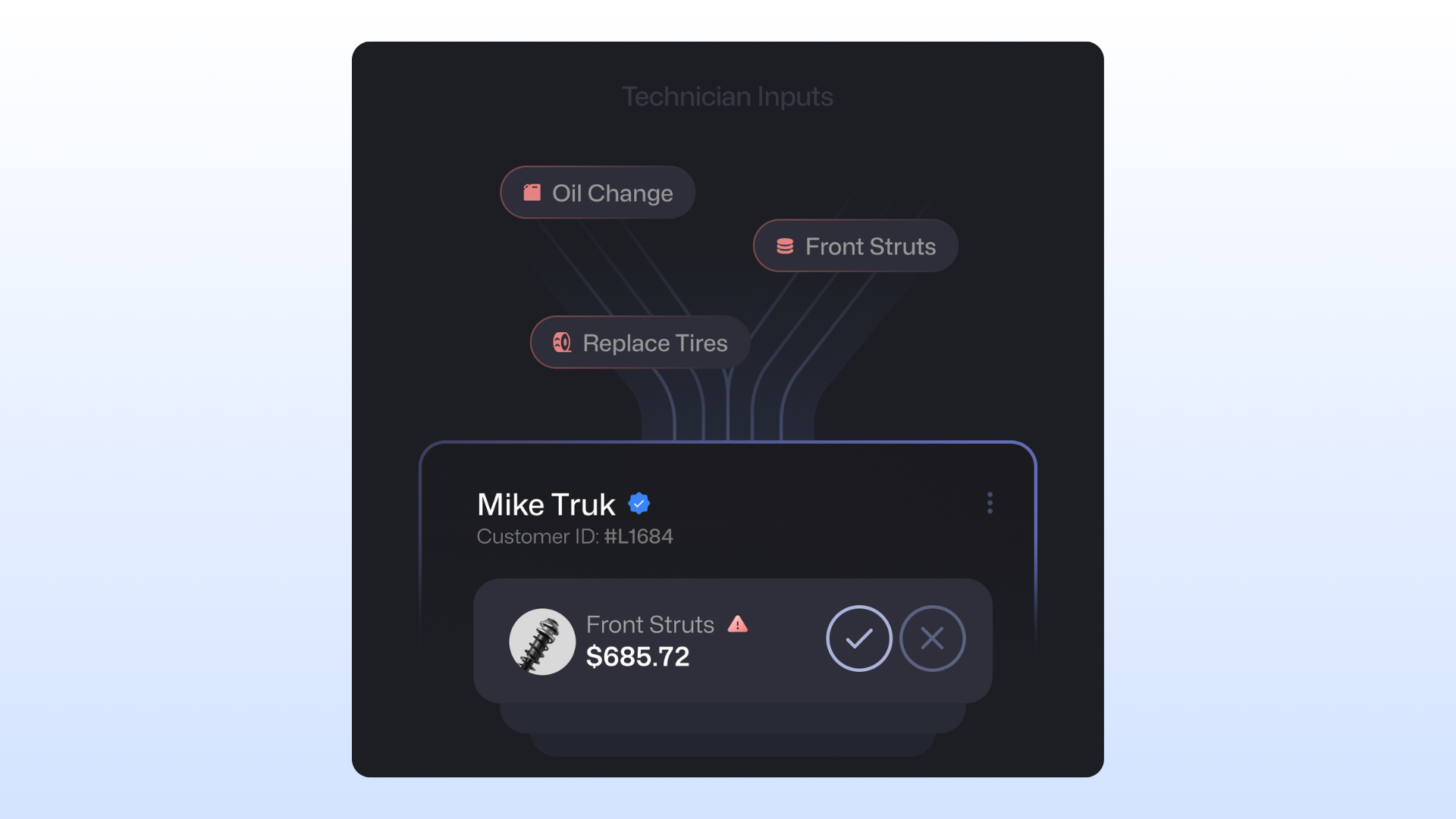
- Service AI, advisor agentic workflow: turns tech notes into customer-ready summaries and surfaces service recommendations
- Service AI, technician agentic workflow: surfaces data-driven inspection recommendations across the service lane
- T1 Pro: the conversational AI interface that surfaces what matters, recommends next steps, and takes action across dealership workflows
Why the Data Model Is the Real Difference
Agents are only as good as the data they can act on. A platform that unifies all dealership departments—sales, F&I, service, parts, and accounting—in one system gives an agent the full operational context. The agent gets instant access to the same repair order, customer record, and financial history—no sync delay, no missing pieces. A DMS that bolts AI onto a legacy system, or integrates separate systems, has to pull data from multiple places first—working with incomplete context, waiting for data to sync across systems, and often making decisions on information that's already out of date.
This is why "AI-native" and "cloud-native, unified" go together: unified data is what makes AI agents actually useful in a dealership.
Governance, Security, and Compliance
Dealerships hold customer information, financial records, and OEM data. If that data gets exposed—through a breach or misconfigured integration—the cost isn't just regulatory fines, it's customer trust. That's why Tekion holds:
- ISO 42001 certification for AI management (responsible AI governance)
- ISO/IEC 27001 for data security
- SOC 2 Type II for information security
- SOC 1 Type II for financial records
- ISO/IEC 27701 for personal information protection
When comparing AI-native claims, ask for the certifications, not just the demo.
How to Evaluate an AI-Native DMS
- See a live demo of the AI agents to watch how they actually handle real dealership workflows.
- Ask whether the agents access data from one unified system or have to pull from multiple places.
- Ask whether the conversational AI can access your full dealership context without requiring staff to paste sensitive data into external tools—and whether it can actually execute actions, not just answer questions.
- Ask to see AI governance and security certifications (ISO 42001, ISO/IEC 27001, SOC 2 Type II, SOC 1 Type II, ISO/IEC 27701).
- Check OEM approval status for your franchises on the vendor’s site. For Tekion, visit tekion.com/about-us.
Frequently Asked Questions
What is the difference between a legacy DMS and an AI-native DMS?
A legacy DMS requires manual work at every step: advisors rewrite tech notes, chase approvals, route jobs manually. An AI-native DMS embeds agents into those workflows—automatically handling approvals, routing jobs, and surfacing revenue opportunities based on complete dealership data. You move from managing tasks to managing relationships.
What dealership tasks do AI agents handle today?
Scheduling appointments, routing service work and approvals, processing invoices without manual data entry, and scoring and routing sales leads. Essentially, AI agents handle the repetitive steps that eat up staff time — and surface opportunities that might otherwise get missed.
Does an AI-native DMS replace dealership staff?
Agents handle repetitive steps inside workflows and surface insights; staff make decisions and build relationships. Tekion customers report efficiency gains like shorter RO cycle times, fewer manual approvals, and faster invoice processing.






.svg)